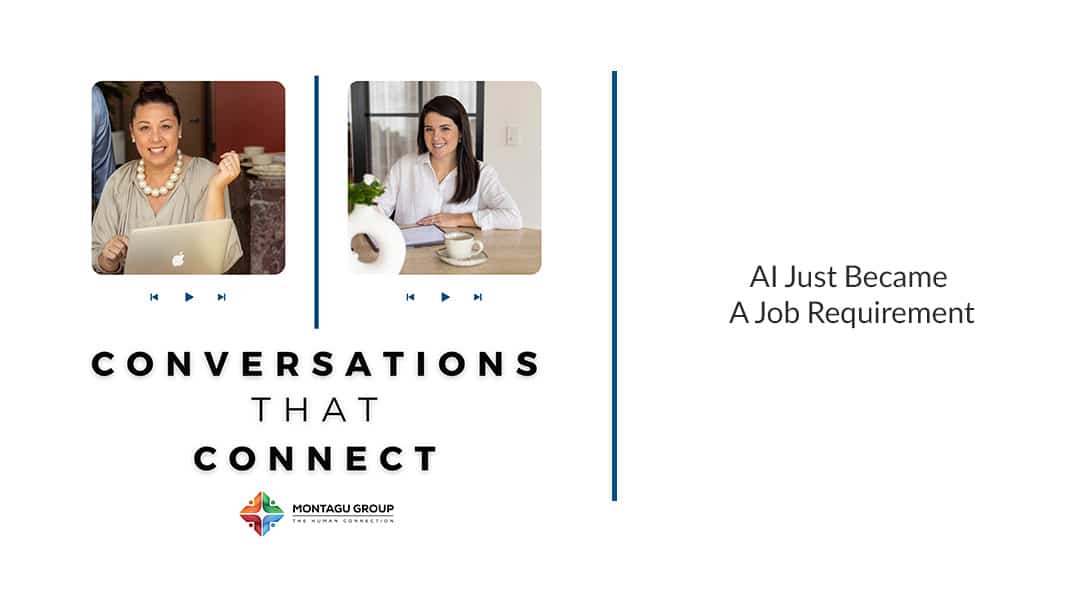
This conversation explores the rapid integration of AI into the workplace, its impact on recruitment, skills development, and organizational transformation. Experts discuss the evolving requirements for AI experience, the importance of strategic implementation, and future workforce implications.

On-the-go listening? We’ve got you covered! Dive into the podcast below and catch up anytime, anywhere. Experience the latest episode on YouTube, or if you’re a bit short on time, grab your headset and tune in to us on Spotify! Dive into the conversation today!

AI Just Became A Job Requirement

It happened quietly—and then all at once.

Over the last few weeks, something has shifted in the hiring market. Not in theory, not in predictions, but in the actual job descriptions being sent to candidates. AI has moved from a “nice to have” to something much more direct.

A requirement.

Recruiters Suki and Tayla summed it up in a way that cuts through the noise:

“It’s no longer just okay to say, ‘I’ve got some experience with AI.’ It’s almost now becoming—show me what you’ve done.”

That one shift—from saying to showing—is where everything changes.


It’s Not About Using AI Anymore

For a long time, candidates could get away with mentioning tools like ChatGPT or Copilot as a signal that they were keeping up. It showed awareness. Curiosity. A willingness to adapt.

But awareness isn’t enough anymore.

Now the question is:

  • What did you actually do with it?
  • What problem did it solve?
  • What changed because of it?

That’s a very different conversation to walk into in an interview.


The Shift Feels Fast—Because It Is

Suki pointed out something that’s easy to overlook:

“It’s literally in the last four weeks that the conversation has really taken a direction where we’ve seen—okay, now it’s on position descriptions.”

Four weeks.

That’s not a gradual transition. That’s a snap.

And when you zoom out, it makes sense. Businesses have spent the last year exploring AI, testing tools, sitting through demos, trying to work out what’s real and what’s just noise. Now they’re moving into execution mode.

“We’ve moved past the AI hype cycle. Now it’s about execution.”

And execution needs people who know what they’re doing.


It’s the Email Moment All Over Again

There’s a comparison in the conversation that sticks because it’s so grounded:

“It’s like knowing how to use email 15 years ago.”

Back then, that was a differentiator. If you knew how to use email properly, you had an edge.

Then, almost overnight, it stopped being impressive—because it became expected.

AI is following that same path. The only difference is the speed.


Every Role Is Feeling It

What’s interesting is how wide this change is spreading.

It’s not just developers or data scientists. It’s:

  • Business Analysts trying to decide which tools actually make sense
  • Project Managers being asked to roll AI out across teams
  • Testers working with AI-driven systems
  • Even roles that historically sat well outside “tech”

Tayla put it simply:

“It’s not a nice to have anymore—it’s mandatory.”

That doesn’t mean everyone needs to become an AI expert. But it does mean everyone needs to understand how AI fits into their work.


The Bit No One Talks About: Businesses Don’t Fully Know Either

Here’s where the conversation gets more honest.

A lot of organisations are still figuring this out themselves.

Suki explains it in a way that feels familiar to anyone who’s worked inside a business:

“If the business doesn’t 100% understand what the requirement is… that can be very vague because there’s so many tools.”

That’s the reality right now.

There’s pressure to “do AI”. There’s budget being allocated. There are expectations from leadership. But the clarity around what problem is being solved isn’t always there yet.

And that creates risk.


When AI Goes Wrong (And It Will)

Tayla raises something that’s already starting to play out:

“There’s obviously been a lot of redundancies… because they are now investing more in AI.”

That’s one side of the story.

The other side hasn’t fully hit yet—but it’s coming.

“They test the product… it doesn’t work… then they’re needing to recruit again.”

We’ve seen this pattern before. Outsourcing went through the same cycle. At first, it was seen as the solution to everything. Then the limitations showed up. Eventually, things settled into a more balanced, hybrid approach.

AI is likely heading in the same direction.


So Where Does That Leave Candidates?

Right in the middle of it.

There’s a moment in the transcript that captures the frustration perfectly:

“I don’t have the experience—where do I get the experience?”

That’s the classic catch-22.

You need experience to get the job, but you need the job to get the experience.

Right now, there’s still a bit of flexibility in the market. Courses, self-learning, and personal projects can still carry weight.

“Although it might not be relevant experience on the ground… that will get you across the line.”

But both Suki and Tayla are clear—this won’t last forever.


The Smart Way to Approach This

Instead of trying to learn everything (which is overwhelming, and honestly unrealistic), the advice coming through the conversation is much more grounded.

Start small. Be intentional.

Tayla puts it like this:

“Find what you’re passionate about… you’ll be the expert in that instead of being an expert in everything.”

That’s the difference between surface-level knowledge and something that actually stands out.


What “Good” Looks Like Now

From a recruiter’s perspective, the difference between a strong candidate and an average one is becoming very clear.

It’s not about listing tools.

It’s about telling a story.

  • What was the problem?
  • What did you try?
  • What worked (or didn’t)?
  • What changed because of it?

Even a small example—done well—can carry more weight than a long list of tools.


There’s Still Confusion in the Market

One thing both recruiters keep coming back to is how overwhelming the AI space still feels.

“There is—it’s overwhelming the amount of tools and software.”

That hasn’t disappeared.

The difference is that the market is slowly starting to organise itself. Tools are becoming more specialised. Use cases are becoming clearer. Businesses are getting more targeted in what they’re trying to achieve.

But we’re not at a stable point yet.

This is still the “storming” phase.


The Roles Are Changing—Not Disappearing

There’s a lot of noise around AI replacing jobs. That’s not what’s coming through here.

What’s actually happening is more nuanced.

Roles are evolving.

“The recruitment might look a little bit different because the role will change.”

Instead of replacing people, AI is reshaping what those people do.

Less manual work. More interpretation. More decision-making. More understanding of systems.


The Window Is Still Open (But Not for Long)

If there’s one part of the conversation that feels urgent, it’s this:

“If you’re not already looking at upskilling now… you’re going to be left behind.”

There’s still time to catch up.

But the expectation is moving quickly. What’s acceptable today—courses, self-learning, early experimentation—may not be enough in six months.


The Bigger Picture

What makes this moment interesting is that everyone is still learning.

Candidates are learning. Businesses are learning. Recruiters are learning.

“We’re learning together… but it’s here.”

That’s probably the most honest way to describe it.

There’s no perfect roadmap yet. No one has it completely figured out. But the direction is clear.

AI isn’t coming.

It’s already part of the job.

Show Notes

Episode Title: AI Just Became A Job Requirement

AI isn’t coming—it’s already here. And more importantly, it’s now showing up in job descriptions.

In this episode, Suki and Tayla unpack the rapid shift happening across the recruitment market, where AI has gone from a “nice to have” to a mandatory skill—almost overnight.

They break down what this means for both candidates and employers, why the change has happened so quickly, and how to navigate the uncertainty that comes with it.

Advice for Candidates

  • Focus on what you’ve done, not just what you’ve used
  • Pick 1–2 tools and go deeper instead of trying everything
  • Build your own examples and case studies
  • Be ready to explain outcomes clearly in interviews
  • Start now—waiting will put you behind

Advice for Employers

  • Define the business problem first, not the tool
  • Be clear on the outcome you want from AI
  • Avoid hiring based on buzzwords
  • Consider bringing in expertise early to avoid costly mistakes

🗣️ Standout Quotes

“It’s no longer just okay to say, ‘I’ve got some experience with AI.’ Show me what you’ve done.”

“It’s like knowing how to use email 15 years ago.”

“We’ve moved past the AI hype cycle. Now it’s about execution.”

“If you’re not already looking at upskilling now… you’re going to be left behind.”

“We’re learning together… but it’s here.”


Episode Highlights

  • 00:00 – Why AI is now appearing in job descriptions
  • 02:00 – The shift from “nice to have” to mandatory
  • 05:00 – Why businesses are struggling to define their AI needs
  • 08:00 – The overwhelming number of AI tools (and what’s changing)
  • 10:00 – Redundancies, investment, and risk
  • 12:00 – The candidate experience gap
  • 14:00 – Why you need to start now

Final Thought

This isn’t a future trend—it’s already happening.

The candidates who move early, experiment, and learn how to connect AI to real outcomes will be the ones who stand out.

Everyone else will be trying to catch up.

Key takeaways

  • AI is now a baseline expectation
    • It’s no longer enough to say you’ve “used AI”
    • Employers want real examples and outcomes
    • AI is being written directly into job descriptions

    The market shifted—fast
    • This change has happened in just the last few weeks
    • Businesses are moving from experimentation to execution
    • Hiring expectations are catching up quickly

    It’s not just for technical roles

    AI is impacting:

    • Business Analysts
    • Project Managers
    • Testers
    • Engineers
    • And increasingly, non-technical roles

    We’ve moved past the hype
    • Early AI adoption was messy and overwhelming
    • Now, organisations want specific solutions to real problems
    • Execution is where the real demand is

    There’s a growing AI talent gap
    • Businesses need people who can connect tools to outcomes
    • Very few candidates can currently do this well
    • This gap creates a major opportunity

    Not every AI investment will succeed
    • Some companies are restructuring to fund AI initiatives
    • Trial-and-error is still happening
    • There may be a cycle of redundancies → failed projects → rehiring

    The future is hybrid roles
    • AI won’t replace most jobs—it will reshape them
    • Roles will combine human decision-making + AI capability
    • Understanding integration is becoming critical

    The “experience problem” is real
    • Candidates are struggling to gain AI experience
    • Right now, self-learning and courses still count
    • That window may close as expectations increase

If you have a burning topic you’d like to discuss, don’t hesitate to reach out at hello@montagu.com.au.

Join the conversation Today!

click on the button to see a full list of posts from our Conversations that Connect deep dives!

Stay Up to Date With Our Latest Episodes

enter your email to be notified when we release a new episode of Conversations that Connect.

0 Comments

Submit a Comment

Your email address will not be published. Required fields are marked *

This site uses Akismet to reduce spam. Learn how your comment data is processed.

x
This website uses cookies to ensure you get the best experience. Learn more